Posts

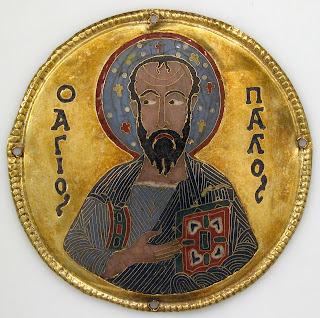
The Rapture of Apostle Paul
Image
With the kind permission of Fr Dr Maximos Constas, below is an excerpt from his chapter “The Reception of Paul and Pauline Theology in the Byzantine Period” in D. Krueger & R. S. Nelson (eds), The New Testament in Byzantium (Washington, D.C.: Dumbarton Oaks Research Library and Collection), 147–76. The Paul of modern biblical studies, and to a significant extent of the modern Christian imagination, is a figure that has been largely constructed in the wake of the Reformation. Justification by faith, the mutual exclusivity of law and gospel, a radical doctrine of original sin and predestination, the repudiation of natural theology, and an opposition between faith and liturgical worship are among the predominant features of Paul as he appears in Wittenberg and Geneva. But there is another Paul, who, though relegated to the margins of modern biblical scholarship, stands at the very centre of the Byzantine exegetical and theological tradition. The Byzantine portrait of Paul places in ...
An Ontological Justification for Icons

Image
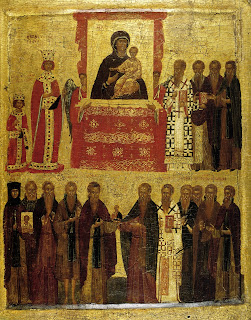
With the kind permission of Dr Anna Zhyrkova, here is an excerpt from her chapter, “John of Damascus’ Philosophy of the Individual and the Theology of Icons” in The Cambridge Intellectual History of Byzantium , ed. A. Kaldellis & N. Siniossoglou (Cambridge University Press, 2017), 431–46. During the seventh and eighth centuries, the Byzantine empire underwent dramatic political and socioeconomic changes. Previously the dominant political entity, it suffered a tremendous loss of territory and political power. While under threat from the caliphate and the Bulgar khanate, it failed to retain political and spiritual connections to Rome, and its economic and administrative systems experienced numerous transformations. Even as it faced the external menace of Islam, internally it was coping with the sociopolitical consequences of the Christological controversies. However, rather than treating this period as analogous to the western Dark Ages, we might consider it an age of redefinition—...

The Presence of Aristotle in Byzantine Theology

Image
With the kind permission of Professor David Bradshaw, below is an excerpt from his chapter, “The Presence of Aristotle in Byzantine Theology” in The Cambridge Intellectual History of Byzantium , edited by Anthony Kaldellis & Niketas Siniossoglou (Cambridge: Cambridge University Press, 2017). Any attempt to survey the place of Aristotle within Byzantine theology must begin by recognizing that the category of “Byzantine theology” is itself a modern construction. The Byzantines did not think of themselves as Byzantines, but as Romans. This fact is not merely a matter of nomenclature, but a reminder of their strong sense of continuity with the classical and early Christian past. As regards theology, in particular, the Byzantines saw no sharp line dividing their own times from the foundational era of Christianity. Although they recognized the authority of the Church Fathers, they did not think in terms of a closed and completed “age of the Fathers.”[1] The holy and God-bearing Fathers...

Divine Desire in the Hymns of Symeon the New Theologian

Image
With the kind permission of Professor Derek Krueger, below is an excerpt from his chapter, “Divine Fantasy and the Erotic Imagination in the Hymns of Symeon the New Theologian” in Dreams, Memory and Imagination in Byzantium , edited by Bronwen Neil & Eva Anagnostou-Laoutides (Leiden: Brill, 2018), 315–341. In addition to many prose treatises and catechetical lectures, Symeon the New Theologian wrote over the course of his life a great many poems called variously “hymns” and “love songs”, although they were neither set to music nor intended to be sung. Around 1035, Symeon’s self-proclaimed disciple, Niketas Stethatos, edited and published a corpus of some fifty-eight of these poems, some of them quite long, totaling over 10,000 verses in three different meters. While it is tempting to read the hymns as intensely personal, the poet consistently engages in ethopoeia , or speech-in-character, constructing a poetic subject engaged in theological meditation and aflame with fervent des...

The Spiritual Senses

Image
With the kind permission of Professor Marcus Plested, here is an excerpt from his chapter in the Dumbarton Oaks Byzantine Symposia volume edited by Susan Ashbrook Harvey & Margaret Mullett,  Knowing Bodies, Passionate Souls: Sense Perceptions in Byzantium  (Harvard University Press, 2017), 301–312.  “If the doors of perception were cleansed everything would appear to man as it is, infinite. For man has closed himself up, till he sees all things thro ’  narrow chinks of his cavern.” —William Blake,  The Marriage of Heaven and Hell — William Blake is just one representative of the long history of the doctrine of the spiritual senses—the idea that there are within the human being faculties corresponding in some manner with the five physical senses, yet capable of direct apprehension of spiritual and divine realities. In Blake’s dazzling if decidedly  sui generis  mystical vision the cleansing of the  doors of perception, the awakenin...

Death and the Afterlife in Byzantium

Image
With the kind permission of Professor Vasileios Marinis, here is an excerpt from his book, Death and the Afterlife in Byzantium: The Fate of the Soul in Theology, Liturgy, and Art  (Cambridge: Cambridge University Press, 2017). At the beginning of the thirteenth century, while on a trip to Italy, George Bardanes, metropolitan of Kerkyra, had an informal exchange about the soul’s fate after death with Fra Bartolomeo, a Franciscan who asked about Byzantine beliefs. Bardanes responded that, because the Last Judgment had not occurred and Christ had not separated the righteous from the sinners, the souls of the departed had not yet received their final and eternal recompense. Rather, they resided in temporary locations, where they experienced a foretaste of their punishments or their rewards of various kinds, allocated presumably according to their conduct in life. Bardanes’s response reflects a desire for an efficiently structured and morally logical afterlife, but it leaves many i...

Dreams & Visions of Early Byzantine Emperors

Image
With the kind permission of Dr Meaghan McEvoy, below is an excerpt from her chapter entitled “Dynastic Dreams and Visions of Early Byzantine Emperors (ca. 518–565 AD)” in   Dreams, Memory and Imagination in Byzantium , edited by Bronwen Neil & Eva Anagnostou-Laoutides (Leiden: Brill, 2018), 99–117. Dreams, visions and portents relating to imperial succession are common literary devices in early Byzantium and have their antecedents in the period of pre-Christian Roman rule. Suetonius reports, for example, that the emperor Nero in the last days of his reign was admonished in a dream to take the sacred chariot of Jupiter Optimus Maximus from its shrine to the house of Vespasian; Cassius Dio reports that he was inspired to write and publish a little book about the dreams and portents which gave Septimius Severus reason to hope for imperial power; while Severus himself dreamt of being suckled by a she-wolf. According to Ammianus Marcellinus, among the various frightening omens ...