Posts

Hymns, Homilies & Hermeneutics

Image
Hymns, Homilies and Hermeneutics in Byzantium , ed. Sarah Gador-Whyte and Andrew Mellas (Leiden: Brill, 2020). The collection of papers in Hymns, Homilies and Hermeneutics explores the literature of Byzantine liturgical communities and provides a window into lived Christianity in this period. The papers reflect a growing interest in the social aspects of the liturgy, begun by pioneering scholars like Mary Cunningham, Pauline Allen, Susan Ashbrook Harvey, and Wendy Mayer. The research questions addressed within are vital for understanding the impacts of the liturgy on the lives and religious understandings of ordinary people, as well as the theologians and clerics of the Byzantine church.  Many of the papers in this book identify hymns and homilies as a means of moral formation in Byzantium. These liturgical texts are a way of shaping listeners’ responses to scripture and encouraging introspection and repentance. In John Chrysostom’s sermons, there is an intriguing connection betwee...
Icon and Idol in the Iconology of Theodore the Stoudite

Image
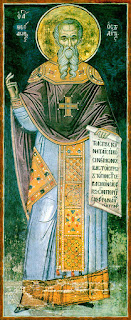
With the kind permission of Dr Ken Parry, here is an excerpt from his article,  ‘ Theodore the Stoudite: The Most “Original” Iconophile?’ published in  Jahrbuch der Österreichischen Byzantinistik (2018), 261-75. In countering the accusation of idolatry, as well as justifying their re-reading of the Exodus prohibition against images, the iconophiles drew a distinction between an icon and an idol. They utilized a distinction inherent in philosophical discussions of nominal definitions. In his Posterior Analytics Aristotle proposed the compound “goat-stag” (τραγέλαφος) as the name of a non-existent thing. However, Plato had earlier used the example of a goat-stag as painted by an artist who combines two animals in one. These mythological creatures, such as gorgons, sirens and griffins, were to be seen in Greek art. This idea of an imaginary animal was discussed by Origen who gave the example of a centaur because it exists only in the imagination. In doing so, he drew a dis...

Theandrites—Studies in Byzantine Philosophy & Christian Platonism

Image
A new book series, Theandrites , published by Franciscan University Press, will explore Byzantine philosophy and Christian Platonism. Frederick Lauritzen (Historian, Scuola Grande di San Marco, Venezia) and Sarah Klitenic Wear (Professor of Classics, Franciscan University of Steubenville) are the series editors. With the permission of the editors, below is some background on the new series. The publication of Plotinus’ Enneads in 301, by his disciple Porphyry, ushered a new era of Philosophy, which lasted until the fall of Constantinople in 1453. This philosophy featured a unique dialogue between Hellenic Platonism and the theology of the Church Fathers and Byzantine Christians. This book series explores the topics which first emerged during this period: Platonism, primarily among thinkers in the Greek-speaking East and their relationship to the Latin tradition in the West, as well as the Christian Platonism found in contemporary Church Fathers, the Greek-speaking Christians in late...

Fate, Free Choice and Divine Providence

Image
With the kind permission of Dr Ken Parry (Senior Research Fellow, Macquarie University), below is an extract from his chapter “ Fate, Free Choice, and Divine Providence from the Neoplatonists to John Of Damascus” in  The Cambridge Intellectual History of Byzantium , edited by Anthony Kaldellis , Niketas Siniossoglou (Cambridge: Cambridge University Press, 2017), 341–60. The history of the concepts of fate (εἱμαρμένη /  heimarmene ), free choice (προαίρεσις /  prohairesis ), and divine providence (θεία πρόνοια /  theia pronoia ) between the fifth and the eighth centuries exemplifies the transition from late antiquity to the Middle Ages in intellectual terms. It was in this period that philosophy and theology developed durable models for the agency of divine providence and its concomitants, the problem of evil, free choice, predestination, justice, necessity, and divine foreknowledge. Both Platonists and Christians devised theodicies to safeguard the sovereign...

Scaling the Text: The Ambiguity of the Book in John Climacus

Image
With the kind permission of Associate Professor Alexis Torrance, here is an except from his article on the ambiguity of the book in John Climacus. For the full text and references, see Byzantinische Zeitschrift 111:3 (2018) 793–808. Early Byzantine monastic attitudes towards books, text, reading, and by extension  learning and   paideia , has long been recognized as an important facet of discussions regarding the broader reception, propagation, neglect, and/or transformation of classical culture in late antiquity and Byzantium. At one end of the chronological and ideological spectrum we have the ever-quotable Gibbon, for whom brutish monks, those “exiles from social life,” being “impelled by the dark and implacable genius of superstition,” had only disdain for any real culture or learning. Gibbon scoffs at the ancient claim that monastics pursued “divine philosophy,” wryly commenting that the monks “surpassed, without the aid  of science or reason, the laborious virtu...

Historical Perspectives on Defining Byzantine Philosophy

Image
On 6 March 2020, scholars will gather at Macquarie University for a promising Workshop: Historical Perspectives on Defining Byzantine Philosophy. The Workshop is convened by Dr Ken Parry and Dr Eva Anagnostou-Laoutides. Below are the abstracts of the presentations. 1. Vassilis Adrahtas, The relationship between theology and philosophy in the work of John Damascene and its bearing on the question of Byzantine philosophy One of the problems that still persist with regards to the definition of Byzantine philosophy refers to the distinction between theology and philosophy and whether such a distinction is possible in the case of the history of ideas of Byzantium. This problem, however, is articulated in a rather simplistic way, insofar as it poses – anachronistically, I would dare say – theology and philosophy as two totally different fields of reference. But Byzantine thinkers seem to have opted for quite an alternative perspective: a perspective of co-inherence.   If Byzantine ...

Providence, Virtue, and History in John Chrysostom and the Stoics

Image
Visiting scholar from Notre Dame University (Indiana), Robert Edwards, will deliver a public lecture on John Chrysostom at Macquarie University (Sydney) in late April 2020. In anticipation of the lecture, Edwards offers a foretaste below.  Scholars have often claimed that John Chrysostom’s moral teaching is, if not Stoic, at least stoicizing. This claim especially applies to Chrysostom’s teaching on what is in our power ( to eph’ēmin ) vs. what is not—that is, the relationship that human choice and action have to externals. For Chrysostom as for the Stoics (so the argument goes) externals are indifferent ( ta adiaphora ), and only virtue can be spoken of, properly, as good ( to kalon, to agathon ). The evidence which is typically brought forward to support such a claim is Chrysostom’s use of something approximating a dictum of Chrysippus, the “second founder” of the Stoic school: “no one can be harmed unless he harms himself.” Chrysostom even has a whole treatise named after i...